 What are We
Solving?
What are We
Solving?
Bitumen in Alberta presents a
unique challenge as it is a solid and not a
liquid. Before bitumen can be recovered it must
be liquified and separated from the solids that
bind it. This process requires energy and until
now, the lack of efficiency of processes used to
recover bitumen have made this a very
energy-intensive endeavour.
As global attention on the
Alberta oil industry increases, the efficiency
challenge has made it difficult for the Alberta
O&G sector to capitalize on the attention in
a positive way. The large amounts of energy
required to extract bitumen has caused much of
the world to look at Albertan oil with disdain.
The present extraction methods of bitumen from
the oil sands have labeled oil products from
Alberta as “dirty oil” and yet the demand for
oil is increasing worldwide.
At Green NABR, we see the
dilemma as a significant one, pertinent to our
time, where the global demand for energy is at
odds with the global demand for sustainability.
In order to reduce the energy requirements of
bitumen extraction and the resulting
environmental impact from such energy
consumption, new highly efficient extraction
technologies are required.
If Alberta hopes to maintain
its reputation as a global leader in
sustainability while exploiting high-viscosity
bitumen, alternatives must be explored.
Alberta
Oil Extraction.
Alberta has a huge reserve of
petroleum locked in the form of bitumen and
heavy oils. Arguably, the Athabasca oil sands
deposits are the largest reserves of oil in the
world. There are only a few technologies
that have proven economically successful in
exploiting these reserves. If the deposits are
near enough to surface, they can be mined and
require enormous amounts of water resulting in
significant environmental impact. If the
deposits are deep enough from the surface,
Steam-Assisted Gravity Drainage (SAGD), can be
used which also requires enormous amounts of
water resulting in significant environmental
impact.
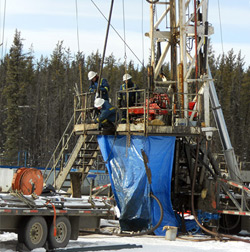 Mining
produces tailings ponds which are topologically
the most significant blemish on the face of the
Alberta oil industry. Extensive research in
reducing the impact of tailings ponds is being
conducted at this time.
Mining
produces tailings ponds which are topologically
the most significant blemish on the face of the
Alberta oil industry. Extensive research in
reducing the impact of tailings ponds is being
conducted at this time.
SAGD involves steam
injection into formations at high pressure.
Solvent addition to the injected steam assists
in recovery with less water. The steam/solvent
mix must take into account the balance between
cost of the solvent and amount of steam required
to penetrate the formation and also heat the
bitumen.
Other research involves the
use of solvent flooding, electrical resistivity
and microwave absorption.
Our
Solution.
Our Green Non-Aqueous Bitumen
Recovery (Green NABR) technology, will be an
ultra-high efficient down-hole treatment.
Our current studies show that it will be
able to reduce the viscosity of product in
various reservoir types including carbonates,
oil sand, and heavy oil formations.
We are working with our
partners to identify the benefits and
limitations of each application in order to best
serve the Alberta oil industry.